Templates
- Example recruitment email for stakeholder meeting
- Example stakeholder meeting agenda
- Example stakeholder input session prompts
- Example stakeholder meeting survey
- Example recruitment email for Crowd the Bay participants
- Example memorandum of understanding
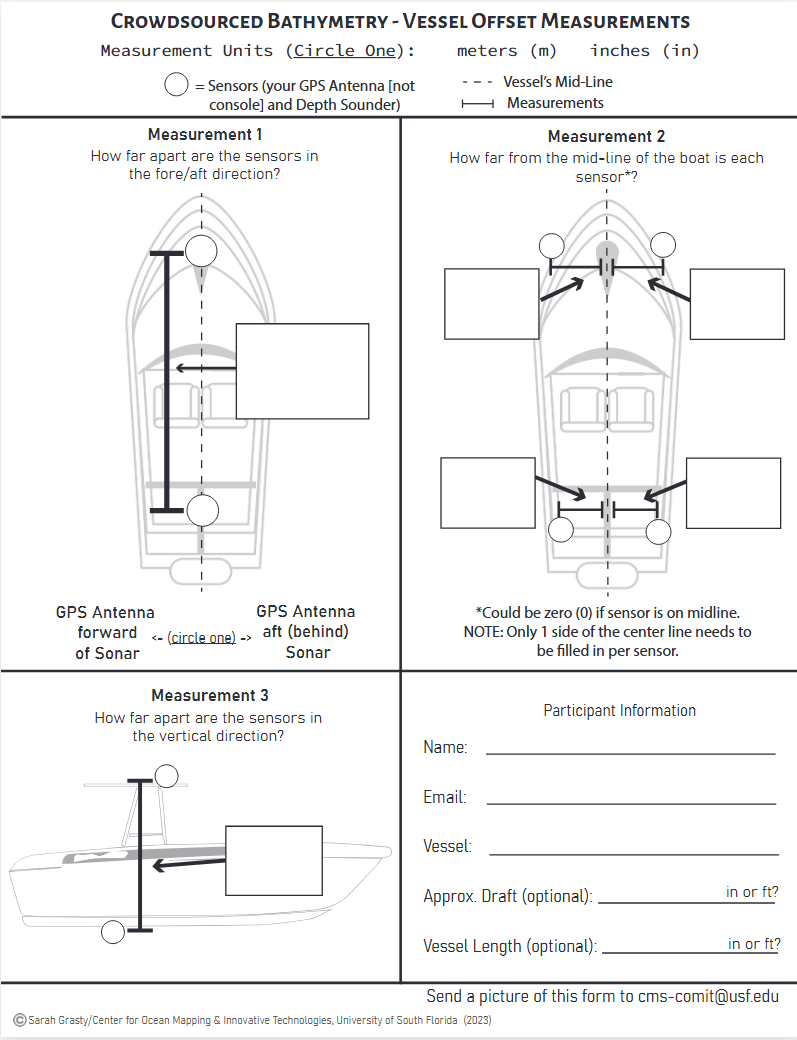
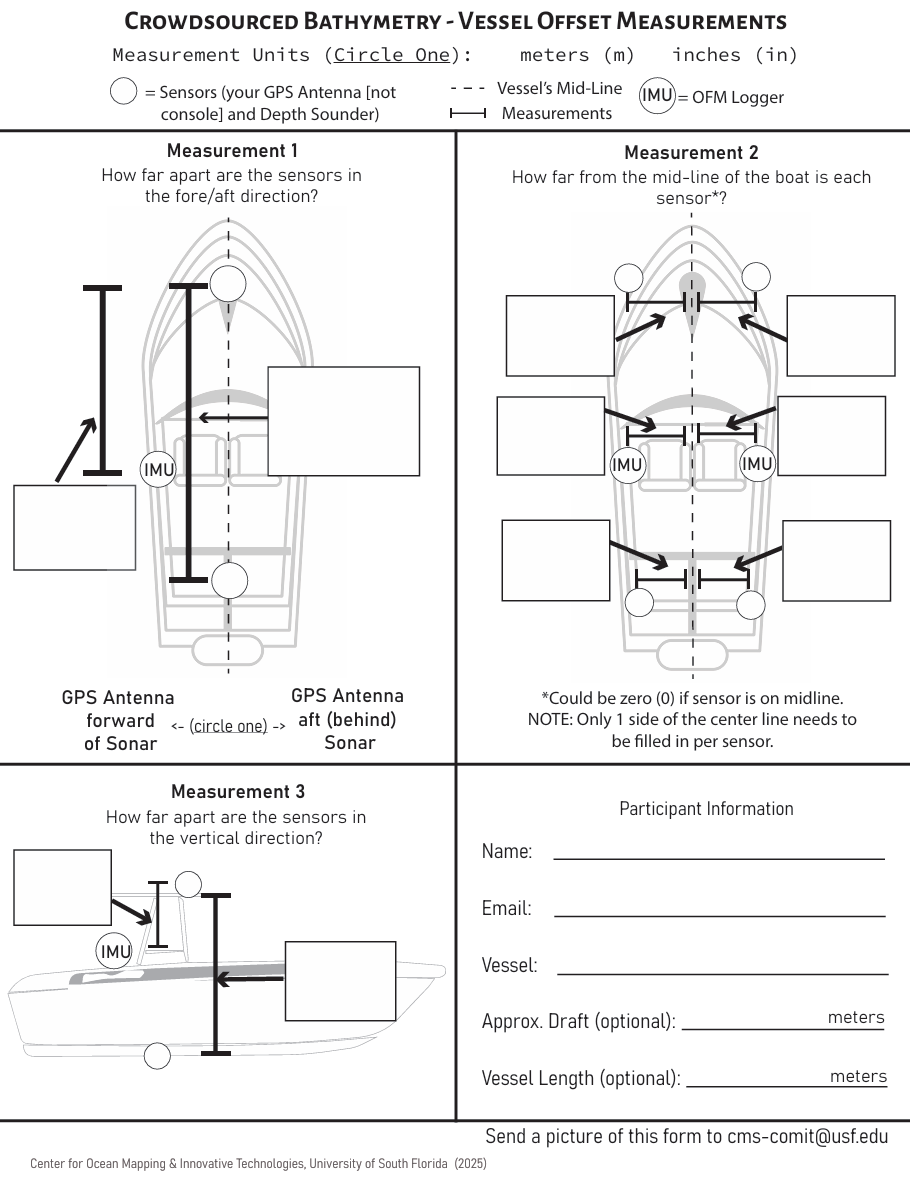
- Example vessel offsets worksheets
- Example letter of agreement and metadata form
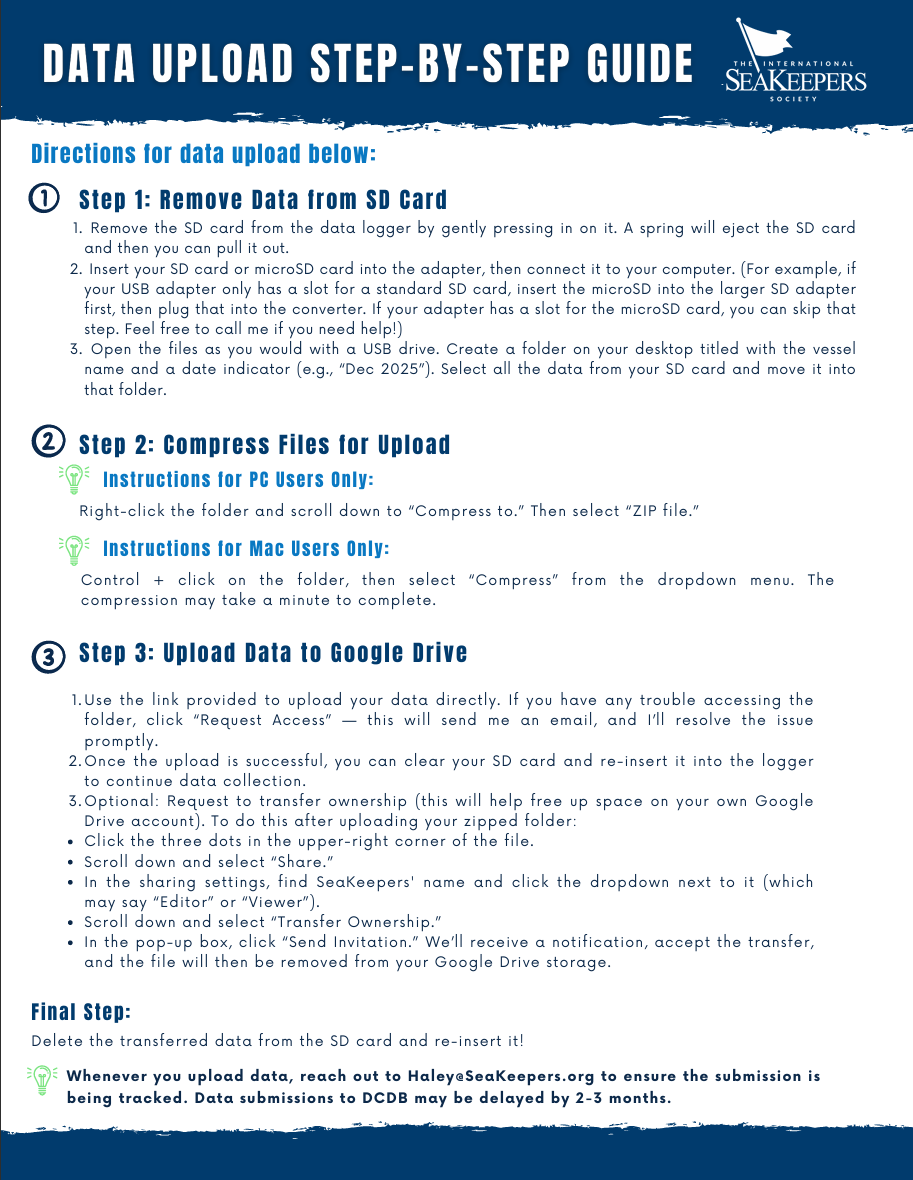
- Example data transfer guide
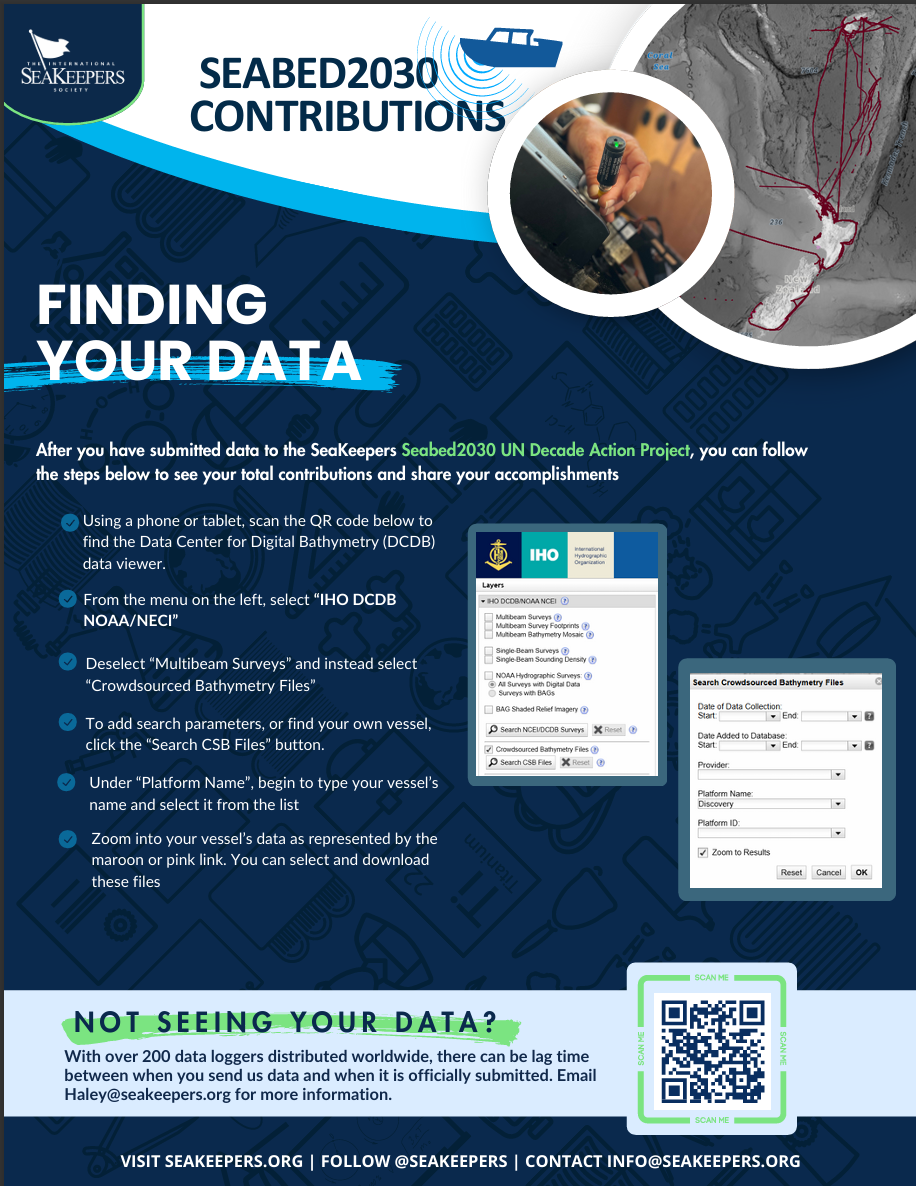
- Example data retrieval guide
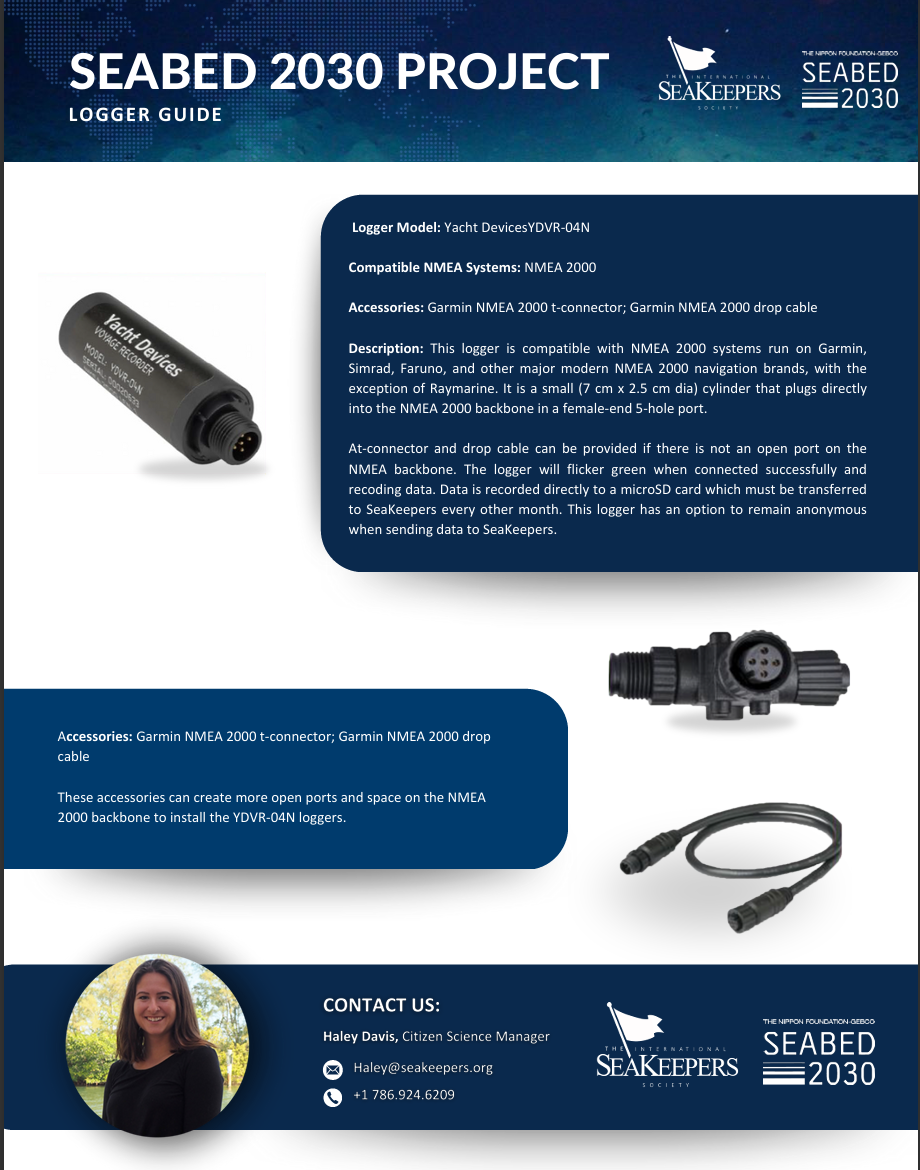
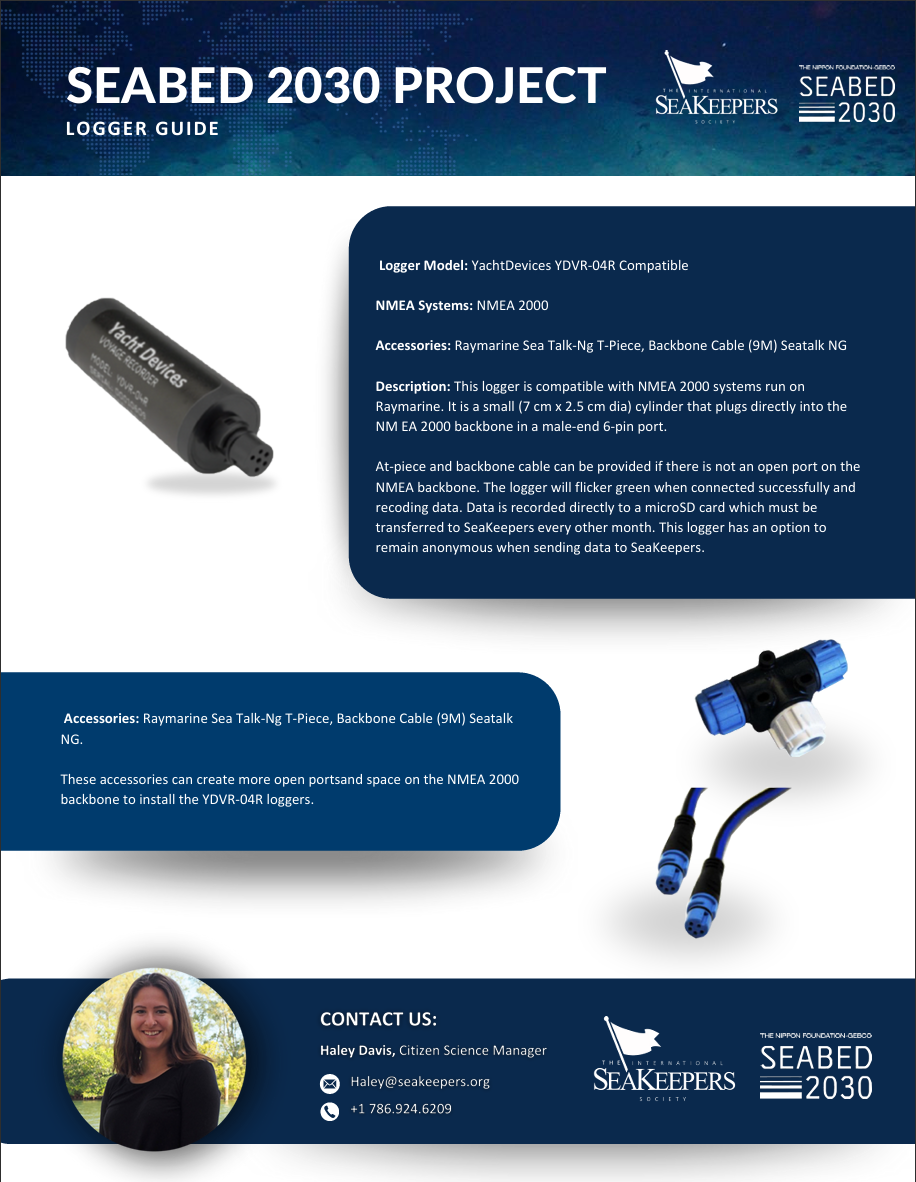
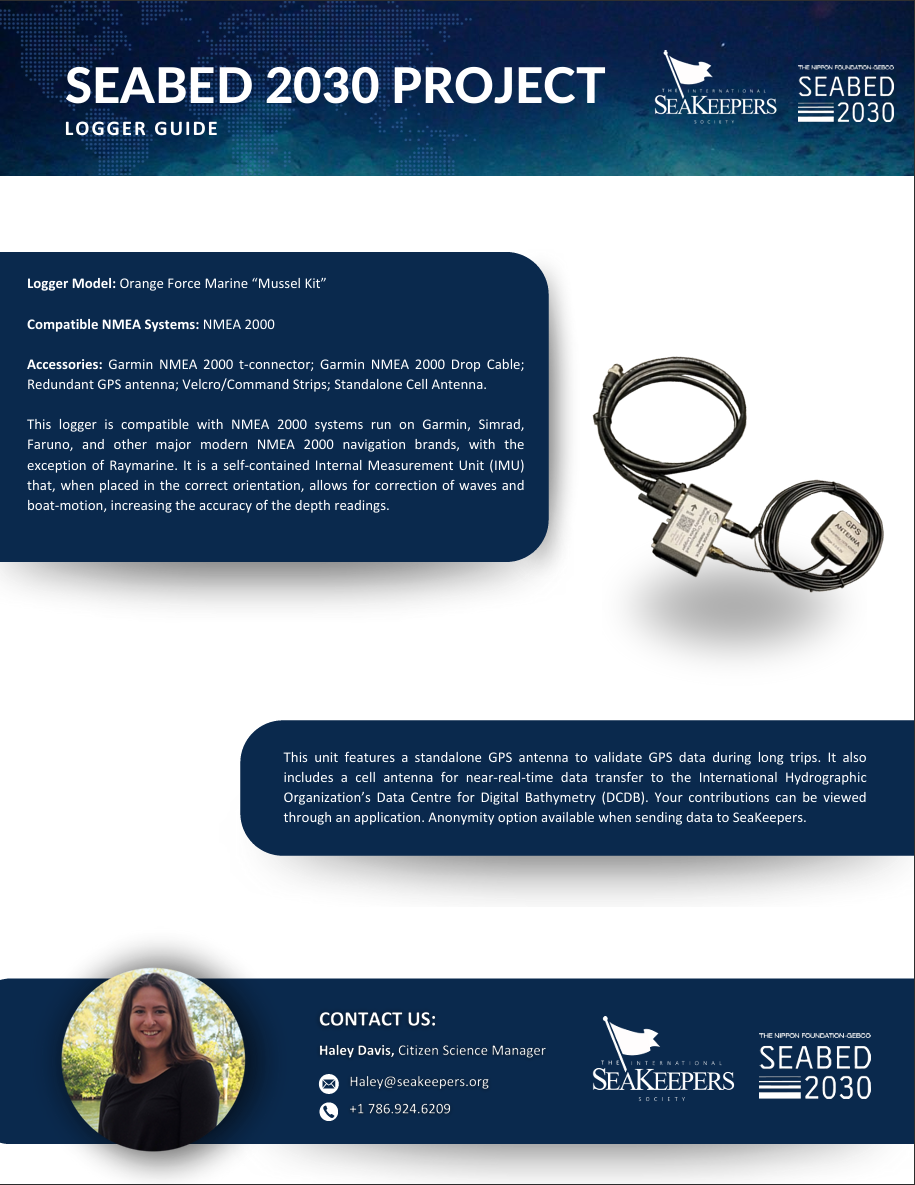
- Example logger menu
- Example internal SOP for a CSB company/program
Example recruitment email for stakeholder meeting
For inaugural stakeholder meeting:
[Fill in highlighted areas with details appropriate to your organization]
Hello,
I’m reaching out to you on behalf of [Your organization name / website link].
We are building a pilot crowdsourced bathymetry (CSB) program focused in and around [Your CSB region]. If you are unfamiliar with CSB, in short it is the collection of seafloor depth from vessels engaged in their routine operations using simple data logger technology.
CSB is a global citizen science initiative with the potential to generate transformative datasets with community benefits such as:
-
Rapid change detection of seafloor features after storm events
-
More frequent updates to nautical charts
-
Improved data for modeling coastal flooding and storm surge estimates
Part of building our program includes working with relevant community members while we’re on the ground floor.
On [Meeting date] we are planning a day-long meeting at [Meeting location] with a small group ([Number of participants]) of invitees from private businesses, government agencies, and nonprofit organizations to formally launch [Your CSB program name].
We have identified your group as a potential participant or stakeholder whose input would be invaluable to the program.
More information will follow but if you or someone from your organization is interested and willing to attend, we ask that you RSVP via this form [Attach link to a Google form / preferred survey format] or respond to this email by [Date].
If you have any questions, please don’t hesitate to contact [POC name and email address]
We appreciate your consideration.
Regards,
[Your name, Organization]
Example follow-up email:
We’re looking forward to hosting you all on [Meeting date] for our first stakeholder meeting as we work to build a crowdsourced bathymetry program in [Your CSB region].
To reiterate the details, the meeting will be at the [Meeting location] at [Meeting time].
[Optional / if providing refreshments] We will provide lunch and refreshments so please let me know if you have any dietary restrictions as we are happy to accommodate.
I’ve created Outlook (attached) and Google events to easily add the meeting to your calendars.
You are not expected to do anything to prepare for this meeting aside from perusing our website [Attach your website link] if time allows. It may be helpful to bring a notebook with you for notes, but no computer or other materials should be needed.
I’ll be in contact as we get closer to the meeting date with final details about how to find parking, the exact meeting location, as well as a brief agenda with an overview of the day.
For second stakeholder meeting:
[Fill in highlighted areas with details appropriate to your organization]
Dear [Recipient's name],
[Your organization] is working to initiate a crowdsourced bathymetry (CSB) program in [Your CSB region].
I immediately thought of you and [Recipient's organization] to be a part of this initiative. I’d like to invite you to a half-day stakeholder meeting on [Meeting date] to learn about and discuss our CSB program.
In short, CSB is a global citizen science initiative that uses simple data logger technology to record depth information from boat echosounders.
We have been building our own regional CSB program, called [Your CSB program name / website link], as part of [List funding agency / initiative, as applicable] for the last [Duration of time / age of program]. We think you/your organization could benefit from, and potentially participate in, this movement to more frequently collect bathymetry (seafloor depth) data in and around [Your CSB region]. I am adding a couple more links that will provide some information prior to the meeting:
A short video by CHS on what installing a logger means, and our Equipment Check webpage [Add link to your own webpage, if applicable].
The focus of this meeting will be to recap an inaugural stakeholder meeting we had in [1st meeting date], while delving deeper into the practicalities of sustaining a CSB program in [Your CSB region]. We’ll also spend time focusing on the applications of CSB data and how [Your organization] can best serve that information to potential stakeholders, such as yourself.
Our meeting will be [Meeting time] at the [Meeting location]. More details will follow, but we ask that if you’re interested to please RSVP via this form [Attach link to a Google form / preferred survey format] as soon as possible or respond to this email by [Date] at the latest.
If you have any questions or would like to be removed from our communications regarding CSB, please let me know.
Regards,
[Your Name, Organization]
Example follow-up email:
We’re looking forward to hosting you all [Meeting date] for our second stakeholder meeting as we work to build a crowdsourced bathymetry program in [Your CSB region].
To reiterate the details, the meeting will be at the [Meeting location] at [Meeting time].
[Optional / if providing refreshments] We will provide lunch and refreshments so please let me know if you have any dietary restrictions as we are happy to accommodate.
I’ve created Outlook (attached) and Google events to easily add the meeting to your calendars.
You are not expected to do anything to prepare for this meeting aside from perusing our website [Attach your website link] if time allows. It may be helpful to bring a notebook with you for notes, but no computer or other materials should be needed.
I’ll be in contact as we get closer to the meeting date with final details about how to find parking, the exact meeting location, as well as a brief agenda with an overview of the day.
Example stakeholder meeting agenda
For inaugural stakeholder meeting:

Crowdsourced Bathymetry (CSB) in Tampa Bay/Florida
Developing a Stakeholder-Driven Process
USF College of Marine Science, MSL Conference Room
140 7th Ave South, St. Petersburg, FL 33713
21 September 2023, 9:00 a.m. – 3:00 p.m.
Goal:
-
Engage local stakeholders in the process of creating a crowdsourced bathymetry (CSB) network in Tampa Bay.
Objectives:
-
Raise awareness about the Center for Ocean Mapping and Innovative Technologies (COMIT) crowdsourced bathymetry Tampa Bay pilot program
-
Acquire input from local stakeholders about the value of crowdsourced bathymetry, participation barriers/concerns
-
Direct input on stakeholder’s ideas and views on tools, outreach materials, and incentivization measures
Deliverables:
-
Pre-and post-meeting baseline knowledge and opinion survey about CSB in Tampa Bay
-
Evaluation of existing products and materials as well as ideas for future development
-
Compilation document of lessons learned and main takeaways
Attendees:
U.S. Coast Guard, United States Geological Survey (USGS), Tampa Bay Ports, Freedom Boat Club, Seabulk Towing, SeaKeepers Society, US Army Corps of Engineers, University of New Hampshire/Center for Coastal and Ocean Mapping, Florida Fish and Wildlife Commission, Sea Tow Tampa Bay
Agenda:
0830 – 0900 Arrival (Parking passes provided), informal coffee/tea social
0900 – 0915 Welcome
0915 – 0930 Pre-Meeting Survey
0930 – 1015 Seafloor Mapping Overview
1015 – 1025 Bio Break
1025 – 1130 Stakeholder Input Session 1: Awareness and use of bathymetry information
1130 – 1145 Lunch Break
1145 – 1215 Optional Tour (or continued lunch break)
1215 – 1315 Stakeholder Input Session 2: Acquiring CSB information
1315 – 1325 Bio Break
1325 – 1430 Stakeholder Input Session 3: Using CSB Information
1430 – 1450 Closing
1450 – 1500 Post-Meeting Survey
Meeting Location & Parking Info:
If you would like a parking pass, we will have some available, but our lot also accepts the Parkmobile app used throughout downtown St. Pete. When you arrive, try to park in a guest space and call/text Name (xxx-xxx-xxxx) to get a parking pass and avoid any parking violation tickets. You can park in any green spots (see map below; green outlines).
The meeting will be in our conference room at the Marine Science Laboratory Building (MSL) at the College of Marine Science on the University of South Florida, St. Petersburg campus, the conference room is near the main entrance (see map below).


For second stakeholder meeting:
Crowdsourced Bathymetry (CSB) in Tampa Bay + Beyond
Developing a Stakeholder-Driven Process
Spring 2024 Meeting
The Suites at Madison, 412 E Madison St 12th Floor, Tampa FL 33602
19 February 2024, 2:00pm – 5:00pm
Goal:
-
Broaden engagement with local stakeholders and possible participants for a crowdsourced bathymetry (CSB) network in Tampa Bay.
-
Distribute data loggers*** to interested participants (limited number available)
Objectives:
-
Briefly review highlights from September 2023 stakeholder meeting.
-
Acquire input from local stakeholders and potential participants about derived data products from crowdsourced bathymetry and the practicalities of sustaining longer term participation in a CSB program.
Deliverables:
-
Report covering the September 2023 and February 2024 meetings
Agenda:
1345 – 1400 Arrival (Coffee and snacks will be provided)
1400 – 1415 Meeting Start/Welcome
1415 – 1445 Recap of previous meeting’s highlights
1445 – 1530 Discussion Session 1: Practical implementation of CSB in Tampa Bay
1530 – 1540 Bio Break
1540 – 1630 Discussion Session 2: Products derived from CSB data for stakeholders
1630 – 1650 Closing
1650 – 1700 Data Logger Distribution
Meeting Location & Parking Info:
We’ll be meeting in the Training Room at the Suites at Madison. This is group space for rent so please be mindful there may be other meetings going on and follow the signs to find the correct room.
There is paid parking under the building as well as street parking throughout downtown Tampa.
***Please try to let us know ahead of the meeting if you/your group is or might be interested in installing a logger***

Contact Info (call/text if needed):
Name: (xxx-xxx-xxxx)

Example stakeholder input session prompts
For inaugural stakeholder meeting:
Crowdsourced Bathymetry (CSB) in Tampa Bay/Florida
Developing a Stakeholder-Driven Process
Stakeholder Input Session #1: Awareness and use of bathymetric information
-
Do you currently use seafloor mapping information? If so, what are your sources of information?
-
Do current seafloor mapping products meet your needs?
-
Can you provide an example of personal and/or professional benefit that might result from participating in CSB data collection and/or using information generated from CSB activities?
Stakeholder Input Session #2: Acquiring CSB Information
-
What features would you want to see on a data logging system, from set-up to use?
-
Do you have current capabilities that would allow you to participate in CSB with minimal adjustments to your activities/operations?
-
What are the major internal and external barriers to CSB participation (e.g., logistics, resources to purchase loggers, instrument and data sharing knowledge and use, long-term leadership of CSB program; see pipeline reference)
-
Is remaining an anonymous data provider important to you/your organization?
Stakeholder Input Session #3: Sustaining CSB Data Collection
-
What types of incentivization could encourage participation in CSB data collection?
-
How should or could CSB data be used to ensure we’re not “collecting data for data’s sake”?
-
What assurances would you need to confidently use CSB data? (e.g., concern about liability for data you provide and/or accuracy of data you use)
For second stakeholder meeting:
Crowdsourced Bathymetry (CSB) in Tampa Bay/Florida
Developing a Stakeholder-Driven Process
Stakeholder Input Session #1: Practical Implementation of CSB in Tampa Bay
-
What is the best way to implement CSB? What might be some possible challenges? More importantly, solutions?
-
Based on what’s been discussed about participant expectations (e.g. physically installing loggers, downloading and sending data), are any of these concerning to participants? Alternatives and solutions?
-
What issues do you see preventing your participation? Can these barriers be overcome or are they non-starters?
-
What types of incentivization could encourage, and more importantly SUSTAIN participation in CSB data collection?
Stakeholder Input Session #2: Products Derived from CSB Data
-
A (near) real-time change map may be a “holy grail” product, but this will require significant R&D. What are other products of interest and/or use? What file types/formats? What does “timely” data mean to you?
-
For the maps that you may use currently for maritime navigation, research, management, etc., what’s missing and does it appear that CSB can fill in those gaps?
-
What assurances would you need to confidently use CSB data? (e.g., error/accuracy, liability)
Example stakeholder meeting survey
Provide the following questions to stakeholders as a pre- and post-meeting survey
Q1 Which of the following aligns most closely with the group you are representing at this
meeting?
- Industry
- Private Business
- Academia
- State Government
- Federal Government
- NGO
- Non-Profit
- Other (please specify)
Q2 How many vessels (or vessel owners) do you or your organization manage or interact with
on a regular basis?
- 0
- 1-5
- 6-10
- 10-25
- >25
Q3 Do you or your organization use bathymetry data (e.g. seafloor depth), such as
navigational charts, on a regular basis?
- Yes
- No
- Maybe/Unsure
Q4 Does your organization participate in any other crowd sourced data collection or citizen
science initiatives?
- Yes
- No
- Maybe/Unsure
Q5 Did you review any of the outreach materials about crowdsourced bathymetry prior to the
meeting?
- Yes
- No
Q6 Do you think seafloor depth (bathymetric) data are critical to coastal management?
- Yes
- No
- Maybe
Q7, 8, 9 How important do you think crowdsourced bathymetry is to:

Q10 Are you aware of other relevant applications of crowdsourced bathymetry not listed in the
previous question? If so, please briefly list below; If not, write N/A.
Q11 Rank which outreach items you would most prefer to use for learning more about
crowdsourced bathymetry programs
______ A website with brief, concise information
______ Short (2-4 min) videos with concise information
______ Written documentation (e.g. standard operating procedures, program outlines)
______ Longer (5-10 min) videos with more comprehensive information
______ 1-page flyers about different topics
Q12 Are there other outreach materials not listed above you would prefer?
Q13 If you were a participant in a CSB program, would you be willing to share your data with the
public?
- Yes
- No
- Maybe/Conditional
Q14 If you were to participate in a CSB program, would you be willing to install a logger yourself
aboard your vessel(s) which would require opening your electronics console(s)?
- Yes
- No
- Maybe
Q15 If no, what is/are your reason(s) or concern(s)? Check all that apply.
- Too much of a time commitment
- Don't have enough technical expertise
- Concerned about breaking or damaging other electronics
- Not my responsibility
- Other (please elaborate)
Q16 If a certified marine technician was available to complete the installation, would you be
amenable to installing a logger?
- Yes
- No
- Maybe
Q17 If you were a participant in a crowdsourced bathymetry program, how many hours per
month would you be willing to devote to the program such as copying and sending data, reading
updates about the program, and attending occasional stakeholder meetings?
- 0 / not interested
- 1-2
- 2-5
Q18, 19, 20, 21 How important do you think the following items are for sustaining and encouraging long-term
participation in crowdsourced bathymetry?

Example recruitment email for Crowd the Bay participants
[Fill in highlighted texts with appropriate information]
Dear [Recipient's name],
The Center for Ocean Mapping and Innovative Technologies (COMIT) has been developing a crowdsourced bathymetry (CSB) program in Tampa Bay, and I thought you and [Recipient's organization] would be a great fit to participate in this initiative.
In short, CSB is a global citizen science initiative that uses simple data logger technology to record depth information from boat echosounders.
We have been building our own regional CSB program, called Crowd the Bay, as part of our NOAA Office of Coast Survey-funded Center for the last two years. We think you and your organization could benefit from, and potentially participate in, this movement to more frequently collect bathymetry (seafloor depth) data in and around Tampa Bay. I am adding a couple more links that will provide some information:
A short video by CHS on what installing a logger means, and our Equipment Check webpage.
I would be happy to speak with you and to dive deeper into COMIT's Crowd the Bay initiative, what it means to be a part of this CSB initiative, the applications of CSB data, and how COMIT can best provide that information to potential stakeholders such as yourself. Data can be provided to you in a variety of formats to best fit your needs. However, shapefiles tend to be the best way to visualize your data. If you are interested, we have instructions for visualizing CSB data from shapefiles with free QGIS software here.
If you have any questions and would like to setup a time to talk, or you would like to be removed from our communications regarding CSB, please let me know.
Regards,
Example memorandum of understanding

The University of South Florida Board of Trustees’ (“USF”) Center for Ocean Mapping and Innovative Technologies (“COMIT”) is a Trusted Node in the International Hydrographic Organization’s (“IHO”) Data Centre for Digital Bathymetry’s (“DCDB”) project entitled Crowdsourced Bathymetry Data Collection (“Project”).
In consideration for the opportunity to participate in the Project, I, the undersigned, therefore agree as follows:
I hereby consent to the participation of the one or more vessels identified below in the Project as organized by COMIT.
I hereby acknowledge the following:
-
my execution of this acknowledgement and release is an inducement affecting USF’s decision to approve my participation in the Project;
-
USF is Trusted Node approved by IHO to systematically receive crowdsourced bathymetry data (“CSB”) collected by vessels or other platforms and deliver them to IHO’s DCDB.
-
USF will provide a data logger for the participant’s one or more vessels, the specific model will depend on the availability of USF’s inventory and the needs of each vessel, and any data logger installed on a vessel is, and will remain, exclusively the property of USF. Participants must have NMEA networks installed on a vessel prior to a data logger being installed.
-
USF prefers participants install their own data loggers and will provide resources and support to make the process quick and efficient. USF will install data loggers if participant sends a written request to COMIT’s Project Leader. However, USF will not be liable for any issues with a vessel because of USF’s installation of a data logger.
-
each data logger uses the vessel’s 12/24DC and NMEA network to log bathymetry data, date, time, and vessel motion as applicable.
-
I, or an individual designated by me, will liaise with COMIT’s points of contact, Sophia Chernoch (xxx@usf.edu) and Kristin Erickson (xxx@usf.edu), every one to three months (based on frequency of data collection) to enable a representative of COMIT to board the participant’s one or more vessels to download data from the data logger.
-
If a Wi-Fi or cellular-enabled logger is installed, the data will be uploaded when in range of the data transfer capability.
-
data collected, including bathymetry data, date, time, and vessel motion, will be edited of any noise and formatted for submission to the IHO’s DCDB, the public repository for CSB data. Each vessel name will be included in the data submitted to the DCDB unless the participant send’s a written request prior to the installation of the data logger to COMIT’s Project Leader stating the participant wants to be an anonymous contributor.
-
I shall permit COMIT to remove any data logger from a vessel within a reasonably time if (i) COMIT requests it be removed from a vessel; (ii) I withdraw my participation in the Project; or (iii) the Project ends.
-
I shall abide by all laws, regulations, ordinances, policies, and rules applicable to my participation in the Project.
I hereby waive all claims and causes of action that I may have, now and in the future, against USF and its trustees, officers, employees, agents, and other representatives arising out of my participation in the Project.
I hereby indemnify USF and its trustees, officers, employees, agents, and other representatives against any actual or potential losses or liabilities, including reasonable litigation costs, arising out of any of my negligent acts or omissions and those of my employees, agents, and other representatives, any failure to uphold my obligations as specified in this acknowledgement and release, or any misrepresentation by me in a statement of fact made in this acknowledgement and release.
I intend this acknowledgement and release to be as broad and inclusive as is permitted by Florida law and if any portion is held enforceable, I would want the court to interpret it as follows: (i) modify that portion to the minimum extent necessary to make it enforceable or, if that modification is not permitted by law, to disregard that portion; (ii) hold that the rest of this acknowledgement and release remains in effect as written; and (iii) hold that any such portion remains as written in any circumstances other than those in which the portion is held to be unenforceable.
I hereby state that I am either or both the owner of the one or more vessels named below and am an authorized representative of the owner of said vessels and have authority to execute this acknowledgement and release.
I am signing this acknowledgement and release voluntarily with full knowledge of its contents and significance.
________________________________________________________________ ______ / ______ / ______
PRINT NAME OF VESSEL OWNER DATE
________________________________________________________________ ______________________ _____________________
________________________________________________________________ ______________________
NAME OF VESSEL VESSEL HIN
Example vessel offsets worksheets
Example letter of agreement and metadata form
Used by the International Seakeepers Society: linked here.
Example data transfer guide
Example data retrieval guide
Example logger menu
Example internal SOP for a CSB company/program
DISCOVERY Yacht Onboarding Process for Citizen Science & Seabed 2030
Version 1. Digital Introduction
Step 1: Application Submission
- The DISCOVERY Yacht (DY) submits their application to participate.
Step 2: Initial Contact by Programming Team
- The regional Programming Team reaches out to the vessel to discuss interests.
- This can be done via email or an introductory call.
Step 3: Interest in Citizen Science (CS)
- If the vessel expresses interest in Citizen Science, connect them with the Citizen Science Manager or the propriate chapter lead.
Step 4: Interest in Seabed 2030
- If the vessel is interested in contributing to Seabed 2030, consider whether the vessel is equipped with the correct tools.
- Depth Transducer
- GNSS/GPS Chartplotter
- NMEA2000 or NMEA0183 backbone CONNECTING THE PREVIOUS TWO
- Ask the vessel to complete a Seabed 2030 Letter of Agreement (this can be a formal letter or a Google Form, as appropriate) and send the Installation Guide to the vessel.
- Proceed with delivering (by mail or hand)
- Data Logger (YDVR-04R for Raymarine, YDVR-04N for others, or NEMO with adapter)
- SD card (no more than 32GB),
- T-connector
- Drop Cable
If you do not have any available, please request these from Rosemarie@SeaKeepers.org
Step 5: Logger Installation and Data Offloading
- Once the logger is shipped, connect the vessel with the Data Scientist for guidance on data offloading specifics. In the introductory email between the vessel and Data Scientist, attach the Seabed2030 agreement if it was done manually (i.e., not via the Google Form). The data scientist will create a personalized google folder for the vessel and walk them through the data offload process.
Version 2. In-Person Introduction
Step 1: Initial Contact by Programming Team
- Connect with the DISCOVERY Vessel in person at an event. Bring to their attention potential for Scientist Led and Citizen Science opportunities.
Step 2: Application Submission
- The DISCOVERY Yacht (DY) submits their application to participate.
Step 3: Interest in Seabed 2030
- If the vessel is interested in contributing to Seabed 2030, consider whether the vessel is equipped with the correct tools.
- Depth Transducer
- GNSS/GPS Chartplotter
- NMEA2000 or NMEA0183 backbone CONNECTING THE PREVIOUS TWO
- Ask the vessel to complete a Seabed 2030 Letter of Agreement (This can be a formal letter or a Google Form, as appropriate.), and send the Installation Guide to the vessel.
- Proceed with delivering (by mail or hand)
- Data Logger (YDVR-04R for Raymarine, YDVR-04N for others, or NEMO with adapter)
- SD card (no more than 32GB),
- T-connector
- Drop Cable.
If you do not have any available, please request these from Rosemarie@SeaKeepers.org
Step 5: Logger Installation and Data Offloading
-Connect vessel with pertinent staff for continued regional engagement in either additional CS or SLE programs. This can be done via call or email.
Step 6: Logger Installation and Data Offloading
- Once the logger is shipped, connect the vessel with the Data Scientist for guidance on data offloading specifics. In the introductory email between the vessel and Data Scientist, attach the Seabed2030 agreement if it was done manually (i.e., not via the Google Form). The data scientist will create a personalized google folder for the vessel and walk them through the data offload process.